By: Natalie Kolody
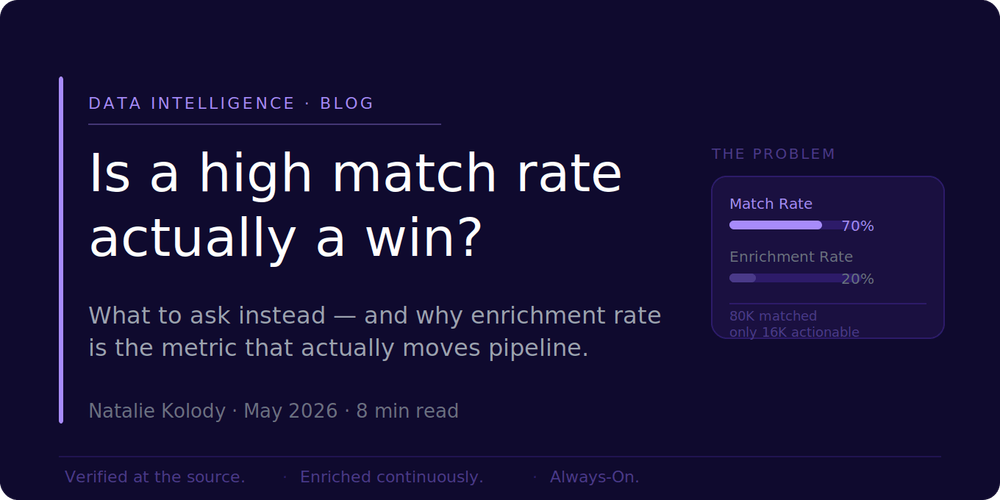
Data vendors love to lead with match rate. It is a clean, confident number. Eighty percent match rate sounds like coverage. It sounds like the vendor knows your data.
What it does not tell you is whether any of those matched records are usable. Whether you now have the emails, phone numbers, and buying signals your team needs to run a program. Whether anything in your CRM actually improved.
Match rate measures recognition. Enrichment rate measures improvement. Most teams treat them as interchangeable. Vendors rarely correct this. The result is wasted spend, inflated expectations, and pipeline that underperforms without a clear reason why.
This post draws a clear line between the two, explains why the distinction matters for every data evaluation you run, and gives you a better framework for measuring what your team actually needs from a data provider.
What is match rate in B2B data enrichment?
Match rate is the percentage of records a provider can identify and link to a profile in their data graph. If you upload 100,000 contacts and the vendor matches 80,000, your match rate is 80%.
Match rate is driven by the strength of the vendor's data graph, email and domain resolution capabilities, and company and contact normalization.
A high match rate tells you that the vendor has broad coverage of your universe. It does not tell you anything about what they do with it.
This is where most evaluations stop. And it is where most data disappointments begin.
What is enrichment rate, and how is it different from match rate?
Enrichment rate is the percentage of matched records that received net-new, improved, or corrected usable attributes. If 80,000 records matched and 40,000 received meaningful updates, your enrichment rate is 50%.
Enrichment rate is driven by three things: data freshness (how recently the vendor verified or sourced the information), field-level coverage (whether the vendor can supply the specific fields your team needs, such as emails, mobile numbers, technographics, and intent signals), and accuracy confidence (how reliably the data is correct, not just present).
A 50% enrichment rate on a base of 80,000 matched records means 40,000 records were recognized but not improved. Depending on what your team needs to run, that may or may not be a passing grade. The answer depends entirely on which 40,000 were enriched and what fields they now carry.
Match rate tells you how much of your data a vendor recognizes. Enrichment rate tells you how much they actually improve it. Optimizing for one without the other is how teams end up with data that looks complete but does not perform.
Why is a high match rate alone not enough?
This is the part vendors rarely explain up front. A high match rate without a corresponding enrichment rate means your vendor recognized your records but did not add much to them. You get the feeling of coverage without the substance. The records come back looking touched, but the fields your team actually needs to reach someone, verified phone, current email, intent signal are still missing.
It creates a false sense of data quality. Teams assume that because a record was matched, it is ready to use. They load it into sequences, fire campaigns, and wonder why connect rates stay flat.
Recognition is not enrichment. Matching is not improvement. The two numbers measure different things, and conflating them is one of the most reliable ways to overpay for data that underperforms.
What are the three match rate and enrichment rate scenarios GTM teams face?
Understanding where your data falls across these three scenarios helps clarify what you are actually getting from a vendor.
High match rate, low enrichment rate. You recognize accounts but cannot act on them. Missing emails, phone numbers, and buying signals mean your team has coverage on paper but not in practice. This is the most common source of data disappointment.
Low match rate, high enrichment rate. Great data on a small subset. The records you do receive are clean and actionable, but limited scale means you cannot run a full program. Depth without coverage is a ceiling.
High match rate, high enrichment rate. Revenue-ready data. Both coverage and depth are working together. This is the only scenario worth targeting, and it requires asking vendors for both numbers, not just match rate.
What questions should GTM teams ask when evaluating a data vendor?
If your team is only asking about match rate in vendor evaluations, you are asking the wrong question. The right question is: how many records become actionable for revenue teams?
That question cannot be answered by match rate alone. It requires evaluating vendors across three layers.
- The first layer is match rate. Can the vendor find my records? Coverage without depth creates a false sense of readiness.
- The second layer is enrichment rate. Do they add fields my team can actually use? Depth without scale does not move the needle on a full program.
- The third layer is accuracy and freshness. Is the data correct right now? A verified record from six months ago may already be wrong.
Accuracy and freshness deserve particular attention. A record can have a high match rate and a reasonable enrichment rate and still be wrong. If the data was verified six months ago and the contact has since changed roles, changed companies, or left the industry entirely, you are enriching with noise. The timestamp on verification matters as much as the verification itself.
This is especially significant for mobile phone data, where vendors relying purely on public data scraping see error rates as high as 60%. Human verification catches what automated validation misses. That distinction is what separates a high enrichment rate that performs from one that just looks good on paper.
How does match rate relate to the validation versus verification problem?
Match rate and enrichment rate are two of the most commonly misread signals in data evaluation. But they are part of a larger pattern.
Validation confirms that a contact method is technically reachable: an email address is deliverable, a phone number is in service, a LinkedIn profile exists. Verification goes further: it confirms that the contact method belongs to the right person at the right company, matched to your ICP. These are not the same thing, and vendors blur that line just as readily as they blur the line between match rate and enrichment rate.
The common thread is that vendors present numbers that make their data look good. Match rate, validation percentage, enrichment rate — each metric, taken alone, tells an incomplete story. Taken together, and evaluated against what your specific GTM motion requires, they tell a much clearer one.
Before your next data evaluation, ask for all three layers: match rate, enrichment rate broken down by field, and the verification methodology behind the numbers. Any vendor worth working with will answer all three.
The bottom line
A high match rate is a starting point, not a result. It tells you a vendor can find your records. It says nothing about whether those records are now ready to use.
The teams getting consistent performance from their data providers are the ones asking harder questions during evaluation: not just whether the vendor matched the list, but what the records look like after enrichment, which fields were added, and how recently the data was verified.
Revenue-ready data requires both coverage and depth. Ask for both numbers, evaluate them together, and hold vendors accountable for the metric that actually matters: how many records your team can act on.
Frequently asked questions
What is a good match rate for B2B data enrichment? Match rate benchmarks vary by industry and database, but match rate alone is not a useful benchmark without the corresponding enrichment rate. A vendor with an 80% match rate and a 20% enrichment rate delivers far less actionable data than one with a 70% match rate and a 60% enrichment rate. Always evaluate both together.
What is a good enrichment rate for a B2B contact database? Enrichment rate depends on the fields your GTM motion requires and how stale your existing records are. What matters most is field-level enrichment rate — how many records now carry the specific attributes your team needs to run outreach, such as verified mobile, current email, and intent signals. A high overall enrichment rate that does not include the fields you use is not meaningful.
Why do vendors lead with match rate instead of enrichment rate? Match rate is easy to calculate and tends to produce larger, more favorable numbers. Enrichment rate requires field-level transparency that exposes gaps in data coverage, freshness, and accuracy. Vendors who lead with match rate and avoid discussing enrichment rate are often obscuring the real performance picture. A vendor that can answer questions about both numbers — including enrichment rate broken down by field and verification methodology — is a more reliable partner.
What is the difference between data validation and data verification? Validation confirms that a contact method is technically functional: an email address is deliverable, a phone number is in service, a LinkedIn profile exists. Verification goes further: it confirms that the contact method belongs to the right person at the right company, matched to your ICP. Most automated data tools stop at validation. Human-verified data providers go to verification. That distinction is what shows up in your connect rate. Teams that switched from validation-only data to human-verified contacts have seen connect rates jump from 11% to 45%.
How does bad data affect AI-powered outreach? Bad data fed into AI workflows does not just underperform, it scales the problem. When AI-powered personalization, segmentation, or automated outreach runs on inaccurate or stale contacts, the errors compound at volume. Sales rep time wasted on bad data is estimated at $37,000 per year, and over 550 hours of GTM team time is lost to data quality problems annually. As teams adopt AI-driven outreach, the data foundation becomes more critical, not less. Clean, verified, enriched data is the prerequisite.
What should I ask a data vendor before signing a contract? Ask for match rate and enrichment rate separately, with enrichment broken down by field. Ask about verification methodology — specifically whether the vendor validates or verifies, and what human review is in the process. Ask how recently records were verified and what the freshness policy is. Ask about mobile number accuracy, since public scraping alone produces error rates as high as 60% on mobile data. And ask whether you can evaluate a sample of records matched to your ICP before committing budget. Vendors who cannot answer these questions clearly are telling you something important about their data quality.